
MIND THE GAP; An Interview with Writer and Director, Steph Wells

Updated: Sep 18

Steph Wells is a film and theatre Writer/Director based in Glasgow, and the Founder of emerging theatre company The Snap Collective. Over the past year, she has produced three runs of her stage play, Mind The Gap, which follows a series of unlikely friendships formed on the London tube. On the brink of her Edinburgh Fringe run, I sat down with Steph to ask her about the processes and inspirations behind the play which has kickstarted her amateur career.
C: So starting with the development process, this play has evolved from three different performances now, all with a unique rotation of cast members. How have you found that evolution to impact both the script and your own writing style over the last year?
S: It's been a really unique and amazing opportunity, because I think it's not often that an artist is able to spend that much time with a piece of work and to see it evolve really organically. Something I've learned from it is to not be so precious about a script, because everyone's going to interpret it in a different way. That's what I've loved being able to facilitate - cast members bringing their own creative licence and contributions to the rehearsal room, feeling able to produce their own interpretation of their character. I've learned to let go of textual specificities - that initially felt so important. Certain references, word and song choices - they don't matter as much as I initially thought they did, because it's more about creating an essence and a message that's larger than the lines.

C: I know when you started this out, the first instalment came from offering free tickets in a university venue, and you've then decided to extend it outwith of a student setting and to take a rather high stakes plunge into amateur theatre making. So how have you realised the play's capabilities over time and what this play could really be? And what gave you that bravery to take it all the way to the fringe?
S: The confidence came from two things. One was the work itself and the love of the people I was working on it with. Our assistant director Roan Joe Nonis has been a constant. Several cast and crew members weren’t available for consecutive versions, but were very supportive of the show and excited about what it could be. And two were the people who came to watch who gave me feedback that I never would have expected. Non-theatre people, I mean. I also wanted to just take a chance on myself. I'm right at the beginning of my career, I'm still working out what I want it to be and how I want to approach it all. So I was like, if there's ever a time to just go out on a whim and beg people for vocal and financial support to make the show happen, it would be now, because later down the line I hope I can support other people in those ways. So there are always hands reaching down to help, you know, everyone needs that at some point.
C: So Mind the Gap was the first production created by the Snap Collective, and we've talked previously about the Snap Collective's commitment to collaboration and community. How have these core values of the Snap Collective impacted the development of Mind the Gap and what it's all about as a play?
S: It's really shaped what the Snap Collective is so far. The show is about community and when you're discussing and rehearsing repeatedly you have to instill those values in the room in order to talk about it productively. But also in order to talk and listen to each other productively. When there's a group of passionate, creative artists in the room there's a lot of ideas spinning about - and this goes back to the learning I had about releasing control and perfectionism. The minute you provide the space for other people to talk and to share what it makes them think of and how they would like to approach it or interpret something, the minute it personifies and embodies all of the things that you're trying to do with the show or say with the show. So I think listening was a big part of it.
C: Live music is such an integral part of this piece and it acts as both a form of transition, as well as a bond between all these characters. So what inspired this use of live music? Was it always part of the script's initial concept or was it added in later as the piece developed?
S: The character of the busker, who creates live music onstage was one of the first things I knew needed to be in the piece. In terms of the role itself, I think it's one of my favourite roles because it's like a ghost. It's like a narrator. We've had two musicians who've assumed that role. One of them chose to play covers. One of them chose to write some of their own music. Both of them were such cool approaches and both of them really made it their own. The busker just brings such a new dimension and element to the show that makes me so happy and also helps the storytelling not feel too strictly episodic. Them playing between every piece of dialogue really ties everything together and creates a consistency and a journey and a form of processing and transitioning that I think is the glue that holds the whole piece together. I’d like to shout out Jonas Leipner and Muriel Boyd who fulfilled these roles, they smashed it.
© Steph Wells
C: The play also has a strong political undertone which doesn't direct the narrative, but rather bubbles beneath the surface and really provides a basis for the characters' underlying motives and beliefs. Why did you decide to add the political undertone to Mind the Gap and why was it important for you to do so? I think if I remember correctly, during the beginning, the first run of the process, there was even a little bit of doubt as to whether to include references to Palestine within the script?
S: All art is political. The hesitancy to include specific lines aboud Palestine was from a fear of being excluded from the institution in which it was being performed in. This was based on some of the narratives they {the University of Glasgow} had put out and ways they had treated direct student political action on campus opposing the Palestinian genocide, but also regarding how people expressed their discomfort and disapproval of all of the investment that the university has had in the arms trade. So the fear came from a fear of criticism to the point of exclusion - that this, in their eyes, was not appropriate material and therefore shouldn't be performed on campus. So it didn't come from a place of fear that this wasn't something important to talk about. The opposite is true. Everything needs a political undertone. It's not always proactively decided. It comes about organically, and is therefore often under-acknowledged.
It was important specifically within the character of Alex to explore his views and protests about the genocide because I didn't feel at the time of writing that enough people were talking about it. I didn't myself feel an expert enough to explore it in any other way. But it felt like such a huge issue that wasn't being talked about enough by the people I was surrounding myself with. I wanted to bring it to the fore, the agenda of people around me, but also myself. London's also such a hub for dialogue about political conflict, and the canvas for many a protest. So for those reasons, it felt completely intrinsic to what the play's coverage could extend to.
C: So as a writer, you have many roots in London, which is really transparent throughout the themes of this play. However, a lot of your personal background has been travelling and living across the world. So is Mind the Gap supposed to be a play inherently set in London, or is it inspired by any other locations that you've lived in?
S: It's not inherently a commentary on London - though does include this - but perspectives you’d hear from characters anywhere. London felt like the reference point I could most closely write from, but from my time travelling… I've always found that taking public transport has been the best way to learn what the social culture of a place is like. So that's definitely been an influence. There's a lot of interactions I've had on public transport wherever I've travelled that have really informed the trip and really informed my understanding of the place I was in. So I think it's also a thank you and an ode to the friendliness of those people I met, some of whom I am still in contact with, or I went on to travel with for longer.
C: What does a fringe run mean to you and mean to the Snap Collective?
S: So much. It's such a dream come true. I've been wanting to do a show at Fringe forever, and I've attended the Fringe year on year, being a flyerer, being a photographer, being a friend, being a fan and a supporter, being an interested, creative person. So it means the world to be bringing a show - that started as a word document of an idea, and has now become so much more.
C: What lies in the future for both you as a storyteller and for The Snap Collective? Now you've put on various productions spanning across both theatre and short film, what direction do you want to explore next?
S: I want to continue exploring my curiosity in the extraordinary things that happen within the ordinariness of everyday life. I think plays and films and TV and all forms of media and storytelling tend to be orientated towards extraordinary, exciting, fabulous, out-of-the-blue things that happen to people, or happen to places. And I think I feel very drawn to that same energy, but finding it in the everydayness and the ordinary mundanity of day-to-day life. So I want to leave my answer vague. I mean, goals-wise, I want to continue creatively exploring the things I'm curious about and providing the platform for other people to do so through The Snap Collective. That's been the biggest thing for me this past year - feeding and exploring that curiosity and creating a group, a place where people can come, and connect, and do those things too.
C: Three words to describe Mind the Gap.
S: Spontaneity, curiosity, listening.
Interview conducted for Wingspan, Issue 1: New Wings
Artwork by © Steph Wells.
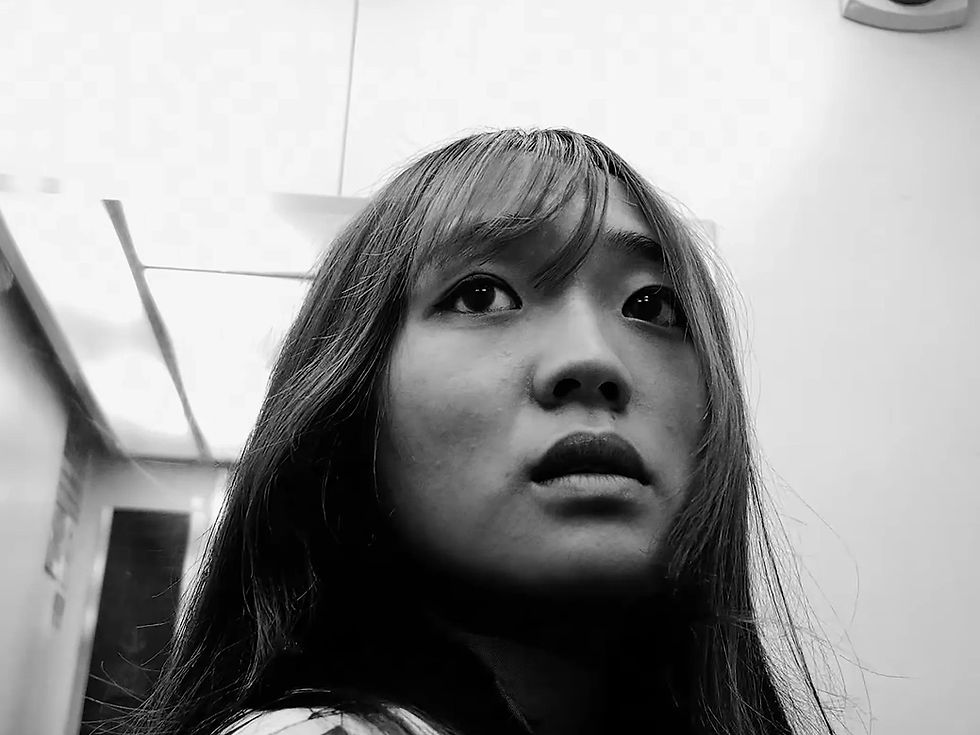
Magic in the monotonous. Magnetism in the mundane. Weighty or wasted? Mind the Gap is a one-act play following strangers as they get chatting – by chance – in the churning belly of the London Underground. One unsuspecting duo nurses an emerging friendship over daily rides on the Piccadilly Line. Can such connections transcend their vacuous circumstances? Can the content of their conversations? Words unspoken between the rails, some sung by a live busker, screech questions about the world they live in and how - despite the trundle of the trains – it’s getting quieter.
Mind The Gap’s Edinburgh Fringe Debut ran from August 21st- 30th at Braw Venues on Hill Street.

Comments